
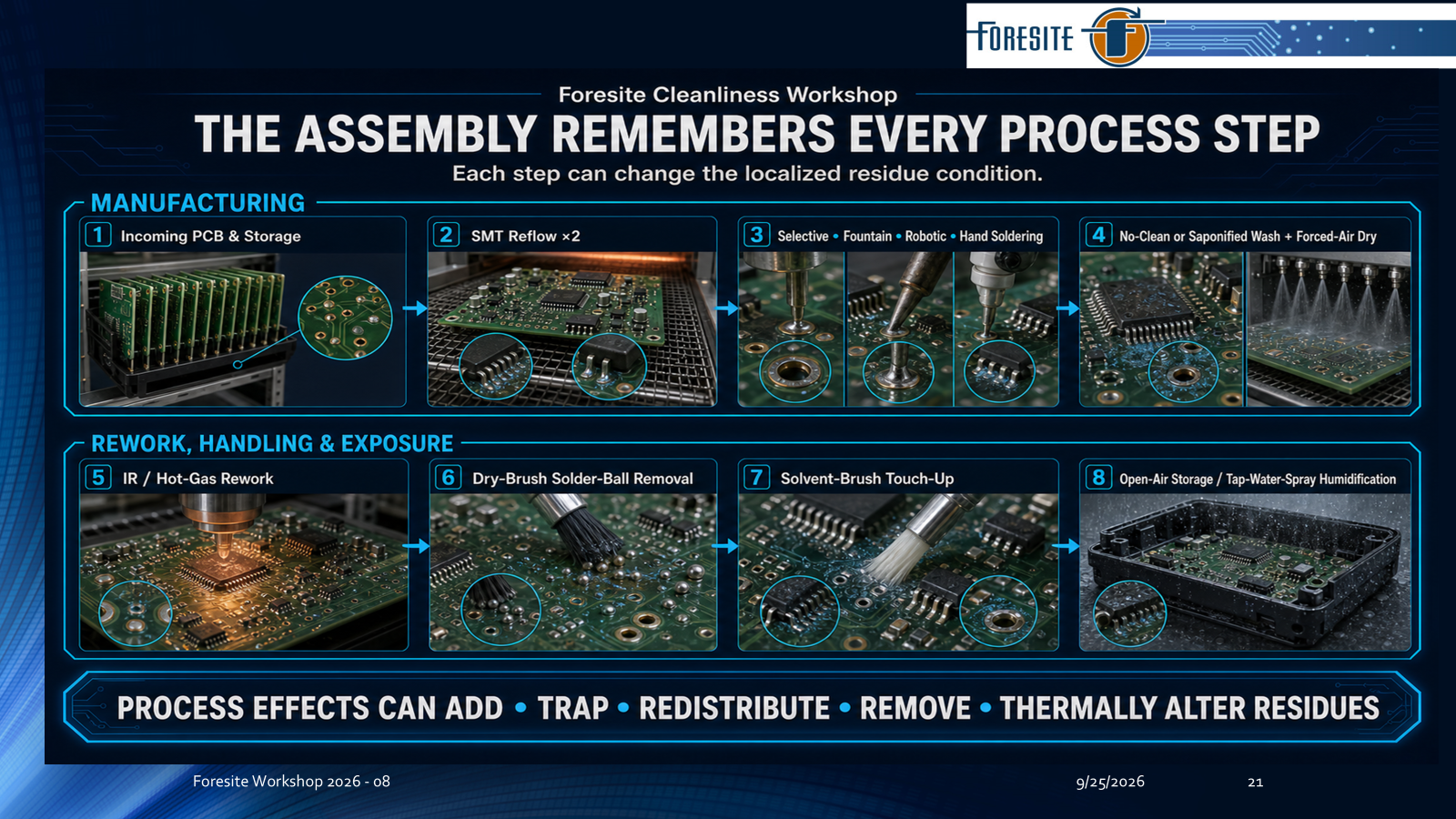
Every step in electronics manufacturing leaves a mark. Some are harder to detect than others.
A printed circuit board passes through numerous manufacturing and handling processes before reaching its final application. Along the way, soldering, cleaning, rework, and environmental exposure can change its contamination profile.
Even when a board appears clean, residues may accumulate, become trapped beneath components, spread, or change chemically when exposed to heat.
Understanding these changes helps prevent contamination-related reliability failures.
How Manufacturing Changes Residue Conditions
PCB contamination doesn't begin and end with soldering. Each manufacturing stage can affect existing residues or introduce new ones.
Incoming Materials and SMT Reflow
Bare boards and components may arrive with residues from fabrication, storage, or handling. During SMT reflow, flux chemistry changes under heat, but uneven heating can leave residues beneath low-standoff components and other difficult-to-access areas.
Secondary Soldering and Cleaning
Selective, fountain, robotic, and hand soldering introduce additional flux and thermal exposure. Flux may spread beyond the intended area, leaving residues where heat is insufficient.
Cleaning presents challenges, too. Depending on chemistry, equipment, and assembly geometry, washing may effectively remove contamination or leave residues trapped beneath components and connectors.
Rework and Repair
Localized heating changes existing residues, while dry brushing and solvent-based touch-ups can redistribute contamination.
Even a successful repair can leave a board with a different contamination profile than it had before rework.
Handling and Environmental Exposure
Open-air storage, humidity, and handling can introduce contamination or alter existing residues.
These effects become particularly important when electronics operate in humid environments.
Five Ways Manufacturing Processes Affect Residues
Manufacturing processes influence residues in five key ways:
Add: Introduce contamination through materials, fluxes, cleaning agents, or handling.
Trap: Leave residues beneath components or in difficult-to-clean areas.
Redistribute: Move contamination during washing, brushing, or repair.
Remove: Reduce residues through effective, validated cleaning.
Thermally alter: Change residue chemistry through repeated or localized heating.
These effects often overlap, making contamination difficult to assess through visual inspection or a single end-of-line measurement.
Why This Matters for Long-Term Reliability
Residue doesn't automatically mean an assembly will fail. Risk depends on its chemistry, location, and environmental exposure.
Under certain conditions, harmful residues can cause corrosion, electrical leakage, electrochemical migration, and intermittent failures. These problems may appear long after manufacturing.
That's why cleanliness evaluations should account for the entire manufacturing history, including soldering, cleaning, and rework.
A More Complete Approach to PCB Cleanliness
Reliable electronics require more than final cleaning. Manufacturers must understand how each process affects residues at critical locations.
At Foresite, we help manufacturers identify and control contamination risks through localized cleanliness testing, residue analysis, and process evaluation, uncovering issues conventional inspections may miss.
Every process step leaves its mark. Understanding those marks is the first step toward more reliable electronics.
Contact Foresite to learn how our testing and analysis services can help identify contamination risks in your manufacturing process.