
No Trouble Found Is Not the End of the Story
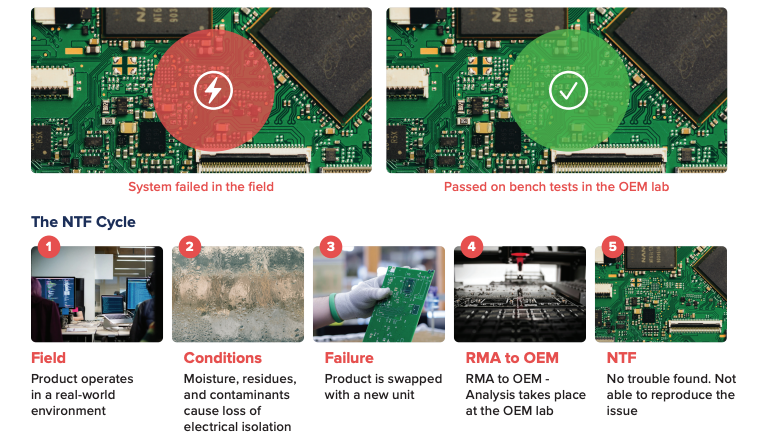
A board fails in the field, gets removed from service, shipped back for evaluation, and then passes every test in the lab. The result is often labeled No Trouble Found (NTF).
But if the product failed for the customer, there was trouble. The real challenge is understanding why the problem disappeared before anyone could reproduce it.
That is what makes NTF investigations difficult. The assembly may look perfectly normal on the bench because the conditions that triggered the failure are no longer present. By the time the product reaches the lab, it may have dried out, cooled down, warmed up, or simply spent enough time outside its operating environment for the failure cause to disappear.
The Lab Is Not the Field
A returned assembly is usually tested in a clean, controlled environment. The field is rarely that predictable.
In the field, electronics may be exposed to humidity, condensation, temperature swings, airborne contamination, process residues, changing electrical loads and more. Any of those factors can influence how an assembly behaves. A board may function normally under dry laboratory conditions but begin to exhibit leakage or intermittent performance once moisture and contamination are introduced.
This is why an NTF result should not automatically be interpreted as proof that the product is healthy. It may simply mean the failure conditions weren’t able to be recreated. The root cause was not identified.
Why Can the Failure Disappear?
One common example involves moisture and ionic contamination. Residues left on an assembly may not cause an obvious problem under normal conditions. Add humidity, however, and those residues can contribute to a reduction in electrical isolation between conductors.
That can create intermittent leakage paths and unexpected circuit behavior. Then the board is removed from the environment, transported back to the lab, and allowed to dry. When it is tested again, the electrical conditions have changed—and the product appears to work.
Electrical isolation is not always fixed. Moisture, residues, atmospheric contamination, and temperature changes can temporarily reduce isolation resistance and affect circuit performance. Once those conditions are gone, the failure may appear to disappear with them.
The NTF Cycle
The pattern often looks like this:
The product operates in the field under real-world conditions.
Environmental factors begin to affect performance, including moisture, contamination, residues, or temperature changes.
The product fails and is removed from service.
The unit is returned to the OEM for analysis under controlled lab conditions.
The failure cannot be reproduced, and the result is labeled NTF.
The important point is that the product did not necessarily fix itself. The conditions surrounding it changed.
What Should You Ask During an NTF Investigation?
When an assembly comes back as NTF, the most useful questions are often about what was different when the failure occurred:
What environmental conditions were present? Was the product exposed to high humidity, condensation, or rapid temperature changes?
Could contamination be contributing to the issue? Process residues or ionic contamination can affect electrical behavior.
What changed before the product reached the lab? Shipping, storage, drying time, and temperature changes can all alter the failure conditions.
Are we testing under realistic conditions? If the problem occurred only in a warm, humid environment, room-temperature bench testing may never reproduce it.
These questions help move the investigation beyond “Does the board work now?” and toward the more important question: Why did it fail then?
Recreating the Failure Is the Goal
The purpose of an NTF investigation should not be to prove that the board works today. It should be to determine why it failed when it did.
Depending on the situation, that may mean:
recreating field temperature and humidity conditions;
evaluating the assembly for ionic or process residues;
looking for evidence of moisture-related electrical leakage; and
comparing electrical behavior under dry and humid conditions.
Those steps can turn an apparently random field failure into something measurable and repeatable.
NTF Is a Symptom, Not a Diagnosis
The phrase No Trouble Found describes one moment in time: the product was tested, and the failure was not reproduced. It does not explain what happened in the field.
That distinction becomes especially important when the same type of product repeatedly fails in service but continues to pass in the lab. Replacing the unit may address the immediate problem, but it does not prevent the next failure if the underlying mechanism remains unknown.
A better question is not simply, “What is wrong with this board?” It is “What changed between the field and the lab?”
Understanding that change is often the key to identifying the true root cause.
At Foresite, we help manufacturers investigate intermittent and difficult-to-reproduce failures by looking beyond the bench test. Environmental exposure, contamination, moisture, and electrical isolation can all provide important clues when a product behaves one way in the field and another way in the lab.
Because when a product fails in service, “No Trouble Found” should be the start of the investigation—not the end of it.