
Understanding PCBA Cleanliness, Part 3: Beyond Manufacturing—Environmental Factors That Impact Reliability
In Parts 1 and 2 of this series, we discussed contamination introduced during the assembly process and the importance of understanding, measuring, and controlling PCB cleanliness. But what happens after the board leaves the manufacturing floor?
Many organizations invest significant effort into cleaning processes, cleanliness testing, and process control, only to encounter failures later during environmental testing, storage, shipping, or field operation. When this happens, the assumption is often that contamination was missed during manufacturing.
Sometimes that's true. But sometimes the contamination wasn't on the board at all.
Environmental Test Chambers Can Become a Source of Contamination
Environmental testing is intended to uncover weaknesses before a product reaches the field. Temperature cycling, humidity testing, HAST, and other accelerated stress tests can provide valuable reliability data.
However, one variable is often overlooked: the cleanliness of the chamber itself.
Over time, environmental chambers can accumulate contamination from previous test articles, outgassing materials, adhesives, lubricants, and airborne particulates. Under elevated temperature and humidity conditions, those contaminants can become mobile and deposit onto electronics being tested.
The result? A board may fail environmental testing because of contamination introduced during the test—not because of contamination present when the board entered the chamber.
When contamination-related failures occur, it's important to consider the test environment as part of the investigation. Otherwise, manufacturers may spend valuable time searching for process issues that don't actually exist.
Shipping and Storage Introduce Their Own Risks
It's easy to assume that once a product has been cleaned and packaged, its cleanliness condition remains unchanged until it reaches the customer.
Unfortunately, that's not always the case.
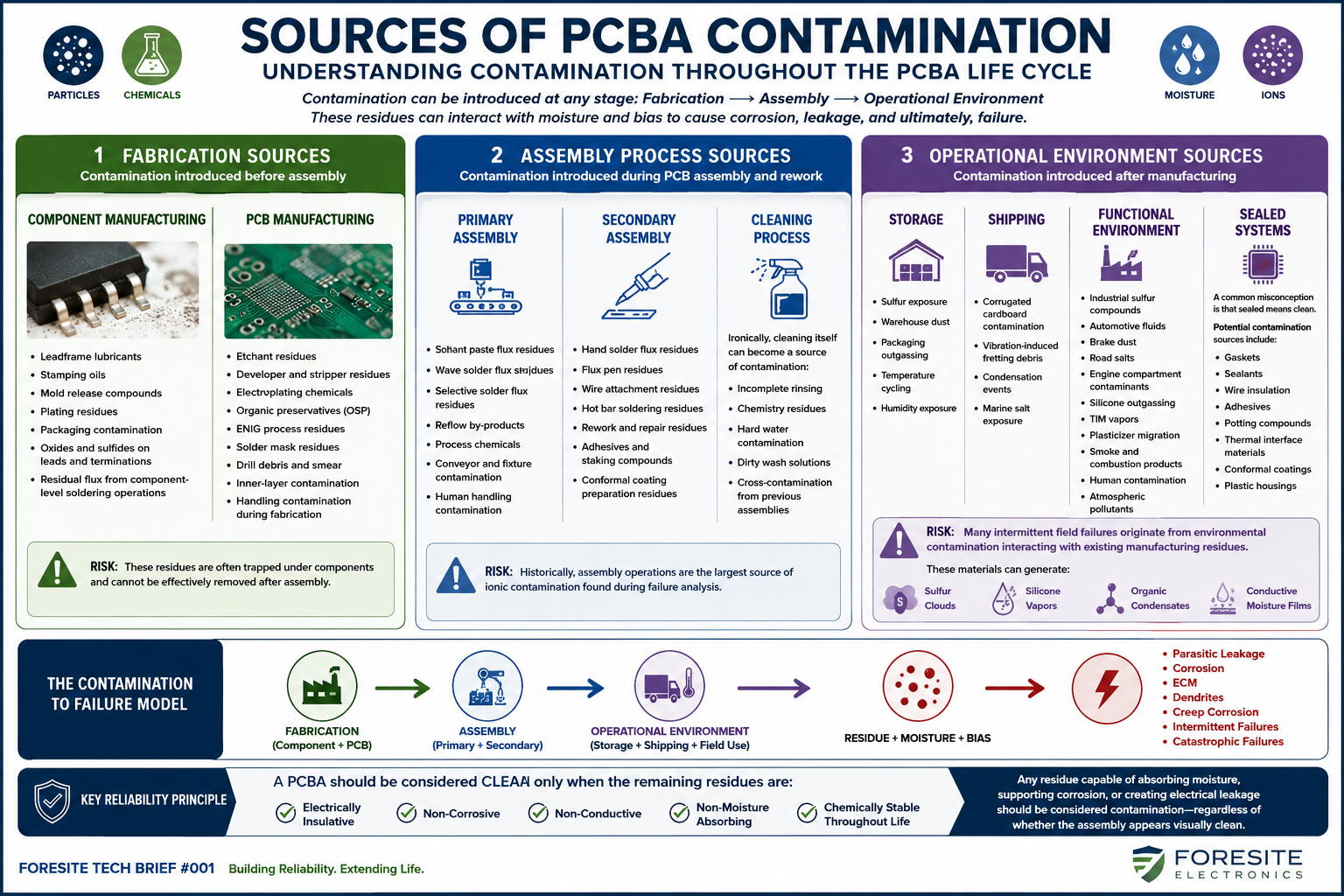
Packaging materials themselves can contribute contaminants. Cardboard, foam, plastics, adhesives, and other materials can release volatile compounds over time. Certain packaging materials may also contain sulfur compounds that can contribute to corrosion concerns for sensitive electronic assemblies.
Moisture is another factor that cannot be ignored. Products may spend weeks or months in warehouses, shipping containers, or uncontrolled storage environments before they are ever powered on. During that time, humidity and temperature fluctuations can create conditions that allow contamination-related reliability risks to develop.
In some cases, the contamination threat isn't coming from the manufacturing process—it's coming from the environment surrounding the product after it has already been built.
The Product Enclosure Isn't Always a Clean Environment
Many engineers think of the product enclosure as protection from contamination.
In reality, the enclosure can become a contamination source of its own.
Modern electronic systems often contain adhesives, staking compounds, thermal interface materials, sealants, plastics, gaskets, and other materials capable of outgassing throughout the life of the product. Inside a sealed enclosure, those materials can create an environment very different from the one the product experienced during manufacturing.
Add moisture intrusion or condensation, and the risk increases further.
Over time, contaminants can accumulate on circuit assemblies and interact with humidity, electrical bias, and temperature cycling. The result may be corrosion, leakage currents, electrochemical migration, or intermittent failures that are difficult to diagnose.
When investigating field failures, it is important to remember that the contamination responsible may have originated from materials inside the product itself.
Cleanliness Doesn't End at Manufacturing
One of the most common misconceptions in electronics manufacturing is that cleanliness is solely a production concern.
In reality, contamination risks follow a product throughout its entire lifecycle.
A board can pass cleanliness testing after assembly and still be exposed to contamination during environmental testing. It can encounter new contaminants during storage and shipping. It can even generate contamination within its own enclosure during normal operation.
Understanding these risks helps reliability engineers ask the right questions when failures occur and avoid focusing solely on the manufacturing process.
The cleanest board leaving the factory is only one piece of the reliability equation. To fully understand cleanliness-related risk, we must consider every environment the product will experience—from assembly to testing, shipping, storage, and ultimately, field operation.